
High-Purity Industrial Chemicals And Water Treatment Sourcing Solutions For Regional Manufacturers
September 29, 2026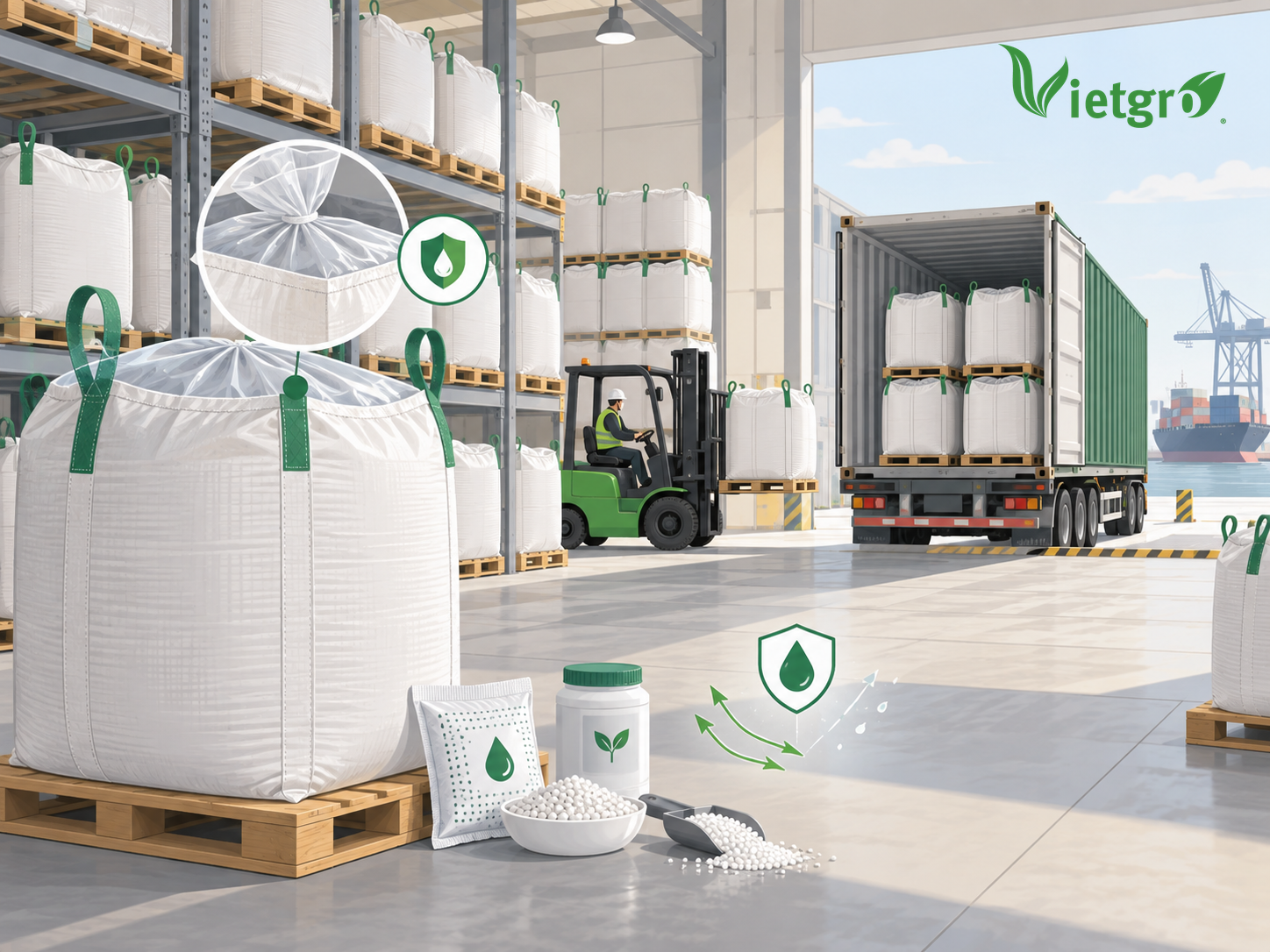
Bulk agricultural fertilizers such as Urea, NPK compounds, Ammonium Sulphate, and Phosphates are inherently hygroscopic. During long ocean transit across high-humidity equatorial trade routes, temperature fluctuations inside shipping containers and vessel holds create moisture condensation and thermal stress. Without preventative engineering, granular fertilizers suffer from caking, nutrient degradation, and particle breakdown, leading to commercial disputes and unloading losses at destination ports.
Vietgro Export Management Company integrates advanced fertilizer formulation controls with specialized industrial packaging from Vietgro Packaging (VGP) to ensure maximum cargo preservation from factory to field.
- Technical Causes of Fertilizer Caking During Ocean Transit
Understanding the physical dynamics of cargo degradation allows buyers and exporters to apply targeted preventative measures:
- Relative Humidity and Critical Relative Humidity (CRH): Each fertilizer salt possesses a specific CRH threshold. When ambient air humidity exceeds this point, fertilizer granules rapidly absorb atmospheric moisture, dissolving granule contact points and forming solid crystalline bridges upon drying.
- Container Rain and Thermal Cycling: Day-to-night temperature swings inside shipping containers cause moisture evaporation from wooden pallets and interior air, condensing on container ceilings and dripping onto top cargo layers.
- Compression Pressure in Heavy Stacking: High stacking configurations inside vessel holds exert intense mechanical pressure on bottom bag layers, accelerating crystal binding if moisture barriers are compromised.
- Packaging Engineering Solutions from Vietgro Packaging (VGP)
Physical barrier engineering serves as the primary defense against transit degradation:
- Multi-Layer BOPP Lamination: Outer Biaxially Oriented Polypropylene (BOPP) film heat-laminated to woven polypropylene fabric provides a continuous, pinhole-free moisture barrier that blocks ambient moisture vapor ingress.
- Heavy-Gauge Inner PE Liners: Inserting high-density or linear low-density polyethylene (HDPE/LLDPE) liners inside woven PP bags creates a dual-sealed interior atmosphere, isolating hygroscopic granules from container condensation.
- Micro-Perforation and De-Aeration Systems: Specialized micro-venting designs allow trapped air to escape during pallet stacking without permitting external moisture penetration, ensuring tight, non-shifting pallet units.
- Best Practices for Warehouse Storage and Handling
Upon port arrival, maintaining cargo quality requires disciplined storage protocols:
- Dry Palletization: Always store fertilizer bags on dry, heat-treated wooden or plastic pallets elevated off warehouse concrete floors to prevent ground-moisture wicking.
- Stacking Limits: Maintain stable stacking heights to prevent excessive compressive pressure on bottom layers. Use interlocking pallet wrap techniques for maximum structural stability.
- FIFO Inventory Rotation: Implement strict First-In, First-Out warehouse management to minimize storage duration in high-humidity regional depots.
By combining precision anti-caking surface treatments with heavy-duty engineered packaging from VGP, Vietgro guarantees granular free-flowing quality upon arrival across global markets.
Consult our technical team for custom packaging and anti-caking export specifications: [email protected]